
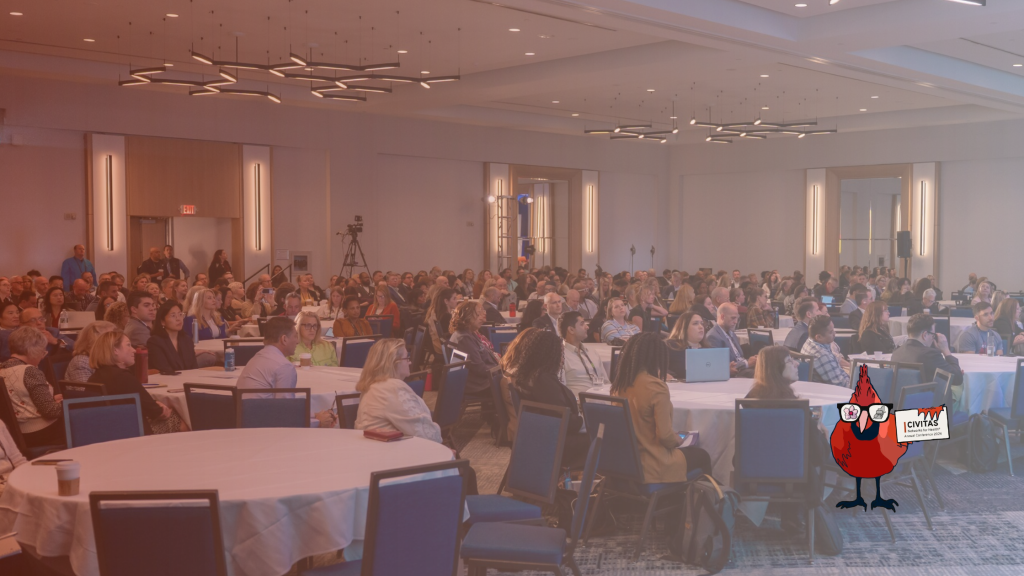
A month ago, 800 leaders from across the country gathered in Arlington, Virginia, for the Civitas Annual Conference. For three days, representatives from health information exchanges, health data utilities, community information exchanges, regional health improvement collaboratives, all-payer claims databases, public health agencies, providers, payers, technology partners, policymakers, and community organizations came together to share ideas, lessons learned, and real-world solutions. The energy throughout the venue was remarkable, but what stood out most was the passion and deep commitment to serving people and communities in the pursuit of continuous improvement for better health outcomes. Every year, our annual conference serves as a powerful reminder of why Civitas exists. It is where we see our network in action:
- Leaders from rural and urban communities sharing strategies to strengthen access to care
- Public health agencies and health information exchanges exchanging ideas about data modernization
- Quality improvement organizations discussing measurement and outcomes
- Community-based organizations, health systems, policymakers, and technology partners explore new ways to work together in service of the people and communities they support.
While the conversations differ, a common theme consistently emerges: the challenges facing our communities are too complex and interconnected for any one organization to solve alone. Often, the challenges facing one community are shared by others, creating opportunities to exchange practical guidance and insights that can be applied across communities.
This is the foundation of Civitas.
The Power of Our Networks
Civitas was built on a simple but powerful belief: meaningful transformation happens when organizations are willing to collaborate across traditional boundaries and push the limits on innovation.
Our membership represents a unique cross-section of the health ecosystem made up of health information exchanges, health data utilities, regional health improvement collaboratives, community information exchanges, all-payer claims databases, quality improvement organizations, public health agencies, providers, payers, technology innovators, community organizations, state leaders, and policymakers.
On paper, these organizations have different missions and responsibilities.
In practice, they are increasingly working toward a shared vision.
Across the country, our members are finding new ways to connect health care, public health, social care, and community services. They are developing governance frameworks that foster trust. They are building infrastructure that allows information to flow where it is needed most. They are creating partnerships that help communities respond to emerging challenges and seize new opportunities.
Most importantly, they are proving that collaboration itself is becoming a critical form of infrastructure.
For years, our industry has focused on building the technical capabilities needed to exchange information effectively so that the data can then be used to create action. This work is essential, and our members continue to lead the way. But as I listened to conversations throughout the conference, I was reminded that the ultimate goal is to make things easier – for patients, providers, payors, public health practitioners, and CBOs.
Across the Civitas network, members are using information to improve care coordination, inform public health initiatives, support rural communities, identify service gaps, advance whole-person care, and strengthen decision-making at every level.
What makes these efforts successful is not simply the availability of data. It is the willingness of organizations to work together around how to make the data usable and what the data reveals.
One message I heard repeatedly throughout the conference and continue to see reflected in member work across the country is that data alone does not improve health. People do. Data is important – data can identify opportunities, highlight disparities, and measure outcomes, but data alone does not create lasting change. This requires collaboration, trust, and action.
That principle is evident in communities large and small. Whether organizations are advancing rural health transformation, building stronger connections between health care and social care, modernizing public health infrastructure, or improving quality and affordability, the most meaningful progress happens when diverse stakeholders come together around shared goals.
Why This Matters
The need for collaboration has never been greater.
Communities are navigating rapidly changing policy environments, workforce challenges, evolving technologies, increasing expectations around data access and interoperability, and growing recognition that health outcomes are influenced by far more than clinical care alone.
No single organization, no matter how innovative or well-resourced, can address these challenges independently.
That reality is what makes our networks so important.
The Civitas networks accelerate learning. They create opportunities to share what works and avoid repeating mistakes. They help local innovations inform broader conversations. They create relationships that allow communities to respond more effectively to both challenges and opportunities.
This is one of the greatest strengths of our community.
Our members are remarkably generous in sharing their experiences, lessons learned, and practical approaches. They understand that improving health is not a competitive endeavor. It is a collective one.
Taking This Impact Forward
As I reflect on this year’s conference, I am grateful not only for the event itself, but for what it represents. The Civitas Annual Conference brings our community together for a few days each year, creating space to learn, reconnect, and imagine what is possible. It allows us to celebrate progress and identify opportunities for future collaboration.
More importantly, it reminds us that we are part of something much larger than what any of us can achieve alone.
Want to be part of what’s next? Save the date for the 2027 Civitas Annual Conference, September 27–29 in St. Louis. Registration will open in spring 2027.
Interested in sponsoring? Reach out to us at . We’d love to explore opportunities together and build a partnership that supports your goals while creating meaningful value for the Civitas community.
